 Translate

SOC 2 Certification in Qatar enables organizations to prove that their systems and processes are designed to protect customer data and ensure service reliability. As businesses in Qatar expand globally and handle increasing volumes of sensitive information, SOC 2 compliance has become a key trust requirement for clients and partners.
First Cert helps organizations in Qatar adopt a structured SOC 2 compliance approach that focuses on practical security controls, risk reduction, and audit readiness. Our consulting services are designed to simplify compliance while supporting business growth and international credibility.
What is SOC 2 Certification in Qatar?
SOC 2 Certification in Qatar is an independent assurance report based on standards defined by the AICPA. It evaluates how well an organization manages data and system controls in line with the Trust Services Criteria:
Security
Availability
Processing Integrity
Confidentiality
Privacy
SOC 2 focuses on ensuring that systems are protected against unauthorized access, data loss, and operational disruptions. Organizations in sectors such as IT services, SaaS, cloud computing, fintech, healthcare technology, and outsourcing benefit significantly from SOC 2 certification by improving governance and stakeholder assurance.
Who Should Consider SOC 2 Certification in Qatar?
SOC 2 Certification is ideal for organizations in Qatar that store, process, or transmit customer or client data, including:
IT and Software Development Companies
SaaS and Cloud Solution Providers
Fintech and Digital Payment Firms
Managed Service Providers and Data Centers
BPOs and KPOs
Health-tech and Digital Healthcare Platforms
E-commerce and Online Service Businesses
For companies serving overseas clients, especially in North America and Europe, SOC 2 compliance is often a mandatory onboarding requirement.
Business Advantages of SOC 2 Certification in Qatar
Organizations that achieve SOC 2 Certification in Qatar gain measurable benefits, such as:
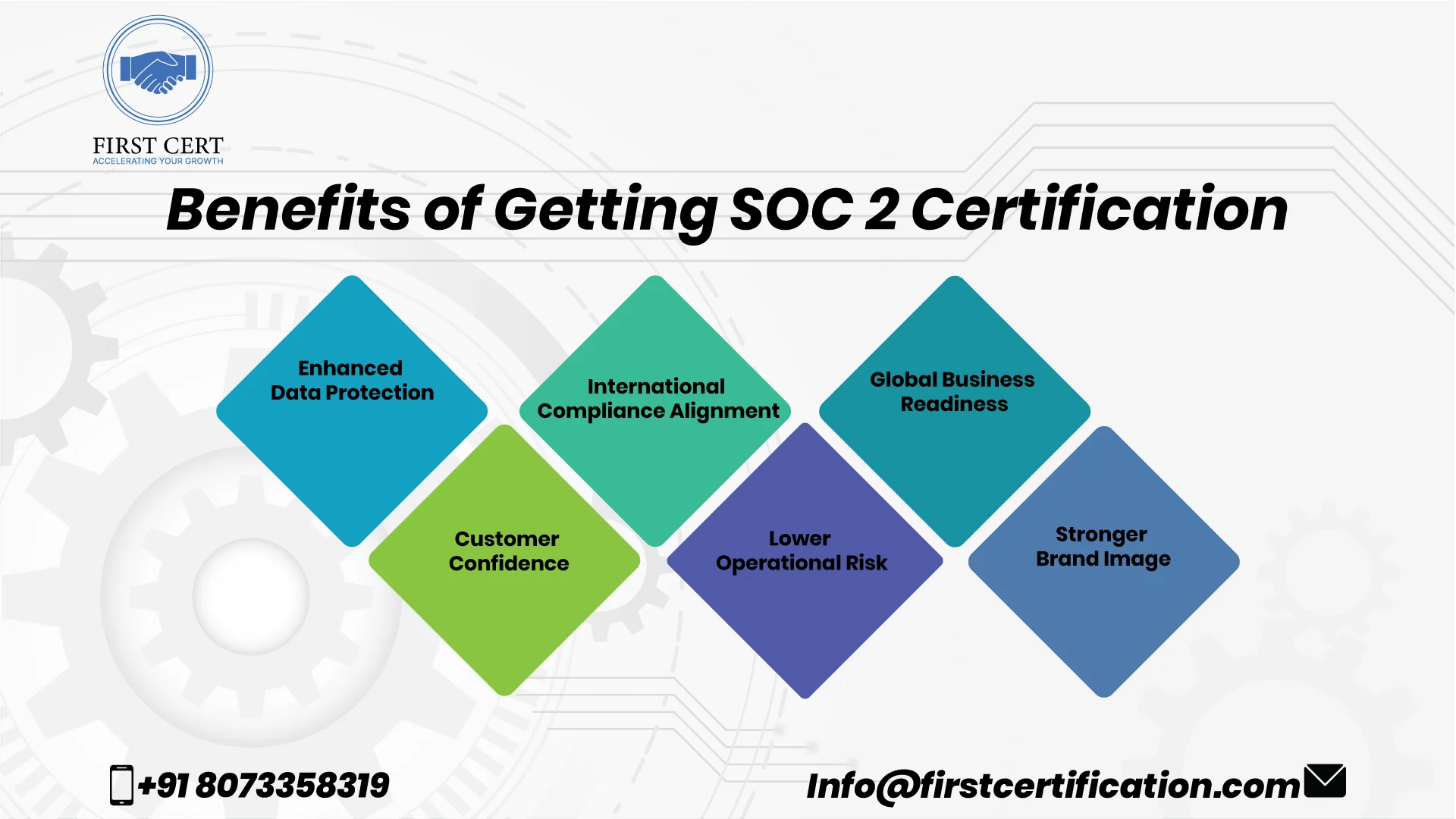
Stronger Data Security Controls to reduce cyber threats.
Increased Client Trust through verified security practices.
Alignment with Global Compliance Expectations.
Lower Operational and Technology Risks.
Improved Readiness for International Contracts.
Enhanced Brand Reputation as a secure and reliable provider.
With First Cert, SOC 2 compliance becomes a strategic advantage rather than just a regulatory task.
SOC 2 Certification Process in Qatar with First Cert
Our SOC 2 consulting methodology is designed for clarity and efficiency:
Scoping & Assessment
Understanding your services, data environment, and compliance goals.
Gap Review
Mapping existing controls against SOC 2 requirements.
Documentation Development
Policies, procedures, risk registers, and control descriptions.
Control Enablement
Supporting implementation of technical and organizational controls.
Internal Readiness Review
Ensuring preparedness before the audit.
SOC 2 Audit Support
Coordination for Type 1 or Type 2 audits with a CPA firm.
Ongoing Compliance Assistance
Support for continuous improvement and future audits.
SOC 2 Certification Cost in Qatar
- Organization size and Service model
- Type of data processed
- Number of Trust Service Criteria in scope
- IT infrastructure and system complexity
- Current security maturity
- Audit type (Type 1 or Type 2) and audit duration
