 Translate

SOC 1 Certification in Qatar is a vital assurance requirement for organizations that process, manage, or support financial information on behalf of clients. As businesses increasingly outsource payroll, accounting, cloud, and transaction-processing services, clients demand greater transparency and assurance over internal financial controls.
First Cert, helps organizations in Qatar design, implement, and validate effective internal controls over financial reporting. Our structured SOC 1 consulting approach ensures your systems, processes, and controls meet international assurance expectations while reducing financial risk and compliance exposure.
What is SOC 1 Certification in Qatar?
SOC 1 Certification in Qatar is an independent assurance report issued in accordance with the AICPA SSAE 18 standard. It evaluates whether an organization has properly designed and implemented Internal Controls over Financial Reporting (ICFR).
SOC 1 focuses on controls that influence the accuracy and integrity of client financial statements, including:
- Financial transaction processing
- Data accuracy and reconciliation
- System and application controls
- Change management and access control
- Security and confidentiality of financial data
Organizations in Qatar that achieve SOC 1 certification demonstrate accountability, control maturity, and reliability to customers, auditors, and global stakeholders.
Which Businesses Need SOC 1 Certification in Qatar?
SOC 1 Certification is recommended for any service organization whose operations affect client financial reporting. Common sectors in Qatar include:
Payroll and HR Processing Companies
Accounting and Financial Service Providers
IT, Cloud, and Managed Service Providers
Data Processing and Transaction Management Firms
BPOs, KPOs, and Shared Service Centers
Fintech and Payment Processing Companies
Risk, Compliance, and Reporting Service Providers
For companies serving international clients, especially U.S.-based organizations, SOC 1 certification is often a contractual requirement.
Benefits of Getting SOC 1 Certification in Qatar
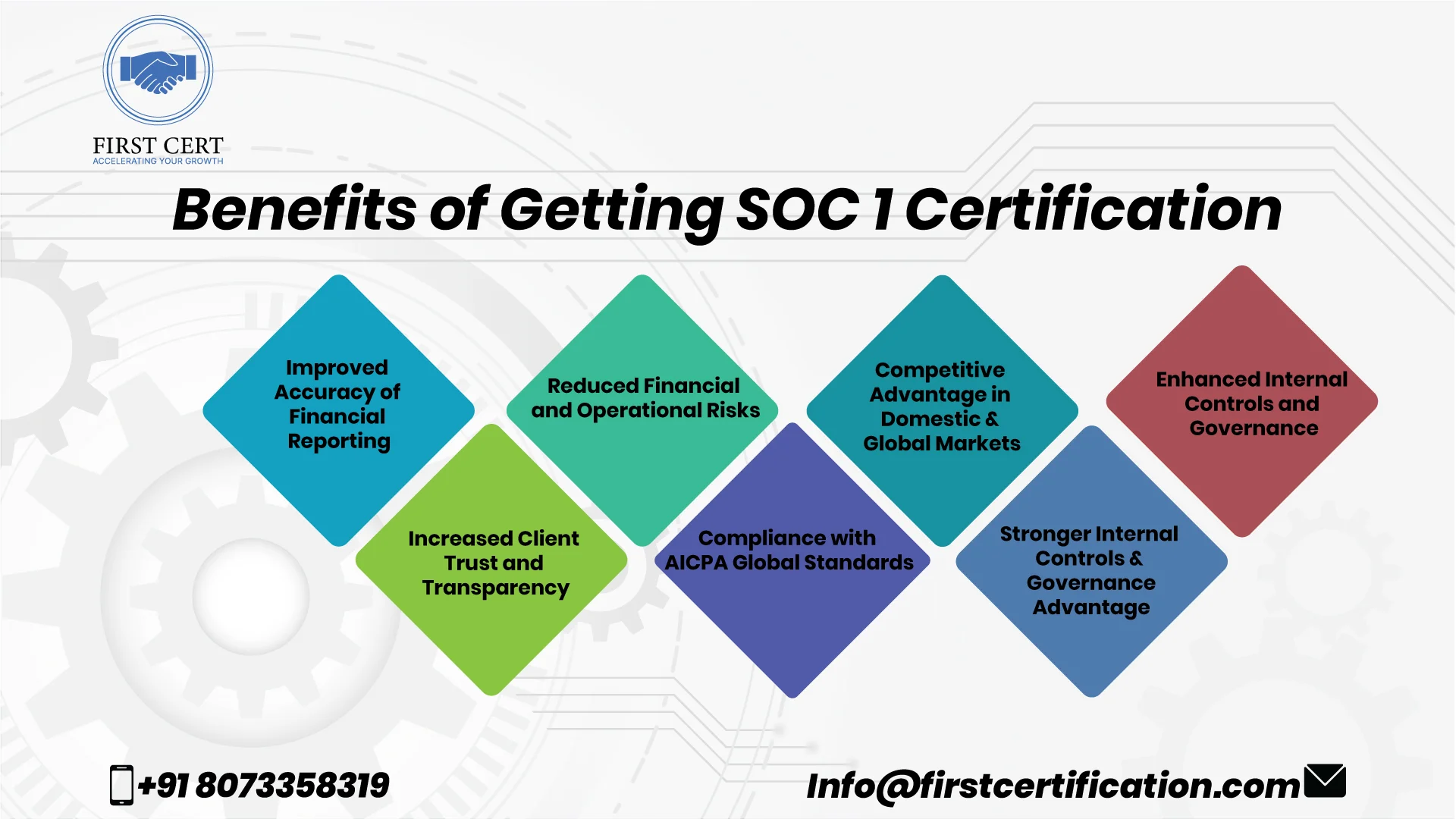
Strengthens accuracy and reliability of financial reporting.
Builds confidence among clients, auditors, and partners.
Reduces operational and financial control risks.
Aligns with globally accepted AICPA assurance standards.
Improves internal governance and control accountability.
Enhances competitiveness in regional and global markets.
With First Cert, organizations in Qatar achieve SOC 1 compliance through a practical, efficient, and business-aligned methodology.
SOC 1 Certification Process in Qatar with First Cert
Scoping & Planning
Define services, financial processes, and SOC 1 boundaries.
Control Gap Review
Identify weaknesses in existing ICFR controls.
Documentation Development
Prepare control narratives, policies, SOPs, and risk assessments.
Control Implementation
Support control design, monitoring, and staff awareness.
Readiness Review
Test controls and validate effectiveness.
SOC 1 Audit Support
Coordinate with licensed CPA firms for Type 1 or Type 2 audits.
Ongoing Compliance
Continuous monitoring and future audit preparation.
How Much Does SOC 1 Certification Cost in Qatar?
- Size of the organization
- Number of financial processes in scope
- Maturity of existing controls
- IT environment and system complexity
- Type of SOC 1 report (Type 1 or Type 2)
- Duration and depth of external audit
