 Translate

VAPT Certification in UAE enables organizations to proactively evaluate the strength of their digital infrastructure against evolving cyber threats. With increasing reliance on cloud platforms, web applications, and connected systems, businesses must regularly test their defenses to avoid data breaches and operational disruption.
First Cert delivers comprehensive VAPT services across the UAE, combining technical expertise with real-world attack simulations. Our approach helps organizations identify weaknesses early, apply targeted remediation, and maintain a strong cybersecurity posture.
Understanding VAPT Certification in UAE
VAPT (Vulnerability Assessment and Penetration Testing) Certification in UAE Certification in the UAE is a structured cybersecurity exercise that examines how systems, networks, and applications respond to attempted attacks. It goes beyond automated scans to validate real exploit scenarios. VAPT activities typically involve:
Discovery of system, network, and application vulnerabilities
Manual and automated penetration testing techniques
Validation of exploitability and potential business impact
Prioritized recommendations for remediation and security hardening
VAPT certification confirms that an organization actively evaluates and improves its security defenses against cyber risks.
Organizations That Need VAPT Certification in UAE
VAPT services are essential for UAE organizations that depend on digital platforms or manage sensitive information, including
IT service providers and software development firms
Cloud hosting companies and SaaS providers
Banks, fintech organizations, and financial platforms
E-commerce businesses and online marketplaces
Healthcare technology and digital health providers
Enterprises operating in regulated environments
Organizations preparing for ISO 27001, SOC 2, PCI DSS, GDPR, or HIPAA compliance
VAPT implementation helps UAE organizations demonstrate responsible cybersecurity management and readiness.
Business Benefits of VAPT Certification in UAE
Organizations that undergo VAPT Certification in the UAE gain multiple advantages.
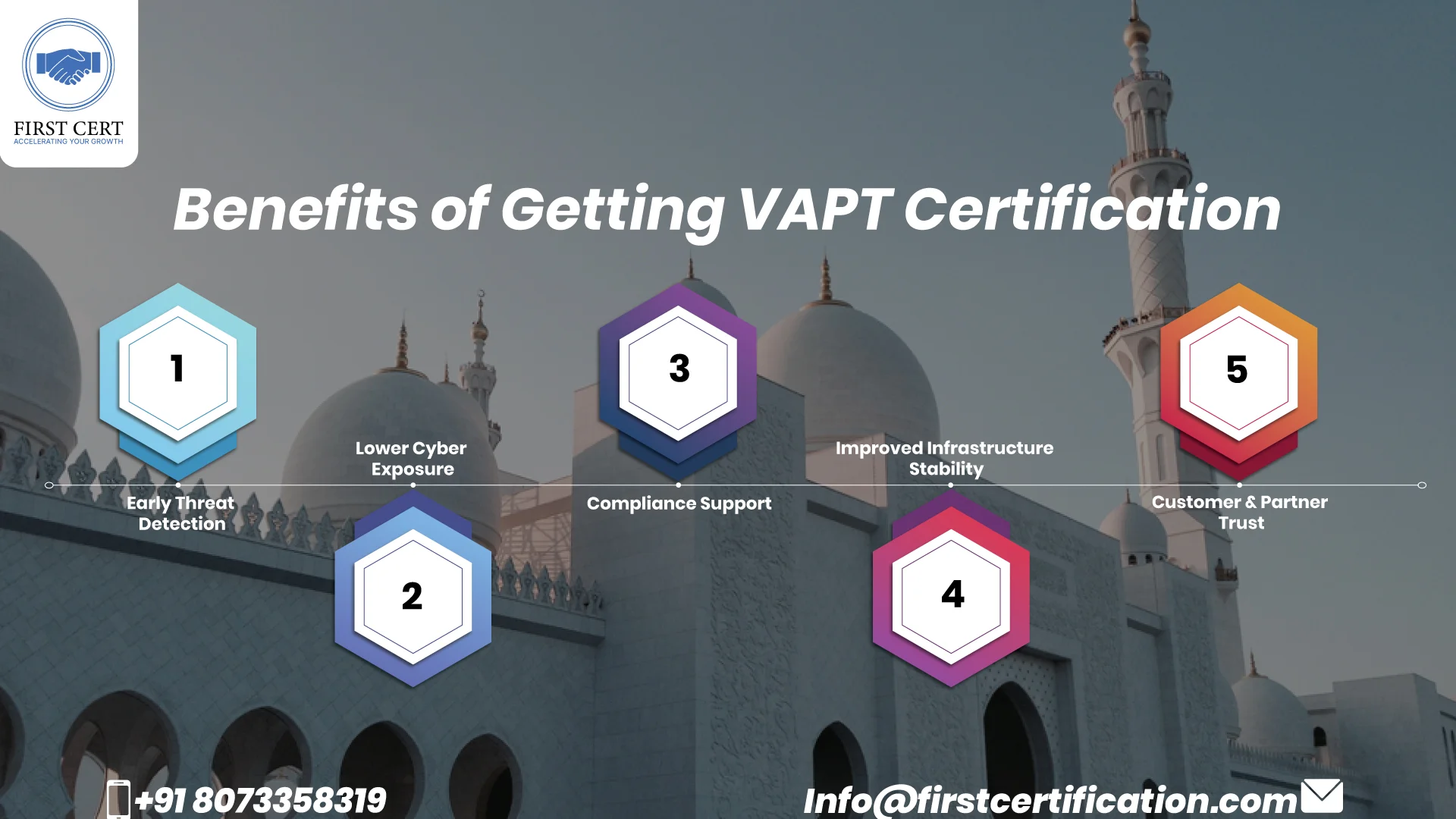
Early Threat Detection – Identifies security gaps before they are exploited
Lower Cyber Exposure – Reduces risks of breaches, ransomware, and service outages
Compliance Support – Aligns with international cybersecurity and audit standards
Improved Infrastructure Stability – Enhances system reliability and performance
Customer & Partner Trust – Demonstrates commitment to strong security practices
VAPT certification strengthens both technical controls and business credibility.
VAPT Certification Process in UAE with First Cert
First Cert follows a robust and business-focused VAPT engagement methodology:
Engagement Scoping
Define assets, systems, and testing boundaries.
Security Assessment
Identify vulnerabilities through automated and manual analysis.
Penetration Testing
Simulate real-world cyberattacks in a controlled environment.
Risk Evaluation
Classify findings by severity and potential impact.
Comprehensive Reporting
Provide clear technical and executive-level reports.
Remediation Guidance
Support fixing identified security weaknesses.
Validation Testing
Re-test systems to confirm mitigation effectiveness.
VAPT Certification Cost in UAE
- Number of applications, servers, and network components
- Type of testing (web, mobile, cloud, API, network)
- Infrastructure size and architecture
- Data sensitivity and regulatory requirements
- Duration and depth of the testing engagement
