
What Happens if an ISO Audit Fails?
Preparing for an ISO audit can be stressful, especially for organizations seeking certification for the first time. One of the most common concerns among business owners and quality managers is, 'What happens if an ISO audit fails?' The good news is that failing an ISO audit does not necessarily mean your organization must start the certification process from scratch. Instead, it indicates that certain areas of your management system require improvement before certification can be granted or maintained.
An ISO audit is designed to evaluate whether your organization complies with the requirements of the relevant ISO standard, such as ISO 9001:2015. Rather than being a pass-or-fail exam, the audit is a structured assessment that helps identify gaps, nonconformities, and opportunities for continual improvement.
This guide explains what happens when an ISO audit is unsuccessful, the types of nonconformities auditors identify, how to resolve them, and how your organization can prepare for a successful re-audit.
If you're planning to implement a Quality Management System, explore our complete guide on ISO 9001 Certification:
Does Failing an ISO Audit Mean Certification Is Impossible?
No. In most cases, organizations that do not achieve certification during the first audit are given an opportunity to correct the identified issues. Certification bodies generally allow organizations to implement corrective actions and provide evidence that the nonconformities have been resolved before making a final certification decision.
The purpose of an ISO audit is to verify compliance and encourage continual improvement—not to penalize organizations for honest mistakes.
Why Do Organizations Fail an ISO Audit?
An ISO audit may identify weaknesses that prevent certification. These findings are known as nonconformities. Common reasons include:
- Incomplete or outdated documentation
- Processes not being followed consistently
- Lack of employee awareness or training
- Ineffective internal audits
- Missing management review meetings
- Failure to address previous corrective actions
- Poor record management
- Weak risk management practices
- Non-compliance with ISO 9001 requirements
Many of these issues can be corrected through proper planning and implementation.
Types of Audit Nonconformities
Minor Nonconformity
A minor nonconformity is an isolated issue that does not significantly affect the effectiveness of the Quality Management System. Examples include:
- Missing signatures on records
- Outdated procedures
- Minor documentation errors
- Incomplete training records
Minor findings usually require corrective actions within an agreed timeframe.
Major Nonconformity
A major nonconformity indicates a significant failure in meeting ISO requirements or implementing the Quality Management System. Examples include:
- Required processes not implemented
- No evidence of internal audits
- Lack of management review
- Repeated unresolved issues
- Failure to control documented information
Major nonconformities generally require corrective action and may delay certification until the issues are resolved.
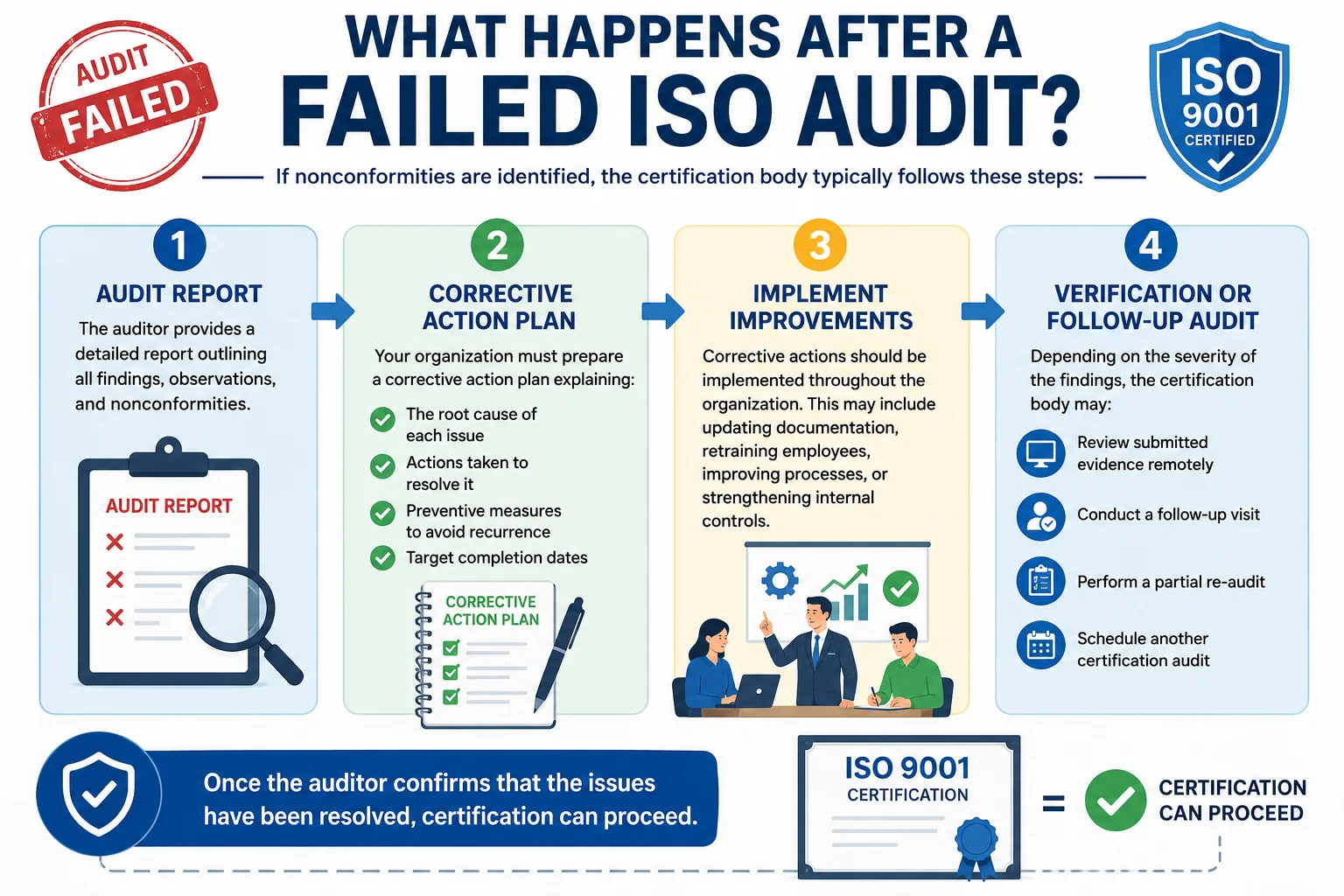
What Happens After a Failed ISO Audit?
If nonconformities are identified, the certification body typically follows these steps:
1. Audit Report
The auditor provides a detailed report outlining all findings, observations, and nonconformities.
2. Corrective Action Plan
Your organization must prepare a corrective action plan explaining:
- The root cause of each issue
- Actions taken to resolve it
- Preventive measures to avoid recurrence
- Target completion dates
3. Implement Improvements
Corrective actions should be implemented throughout the organization. This may include updating documentation, retraining employees, improving processes, or strengthening internal controls.
4. Verification or Follow-Up Audit
Depending on the severity of the findings, the certification body may:
- Review submitted evidence remotely
- Conduct a follow-up visit
- Perform a partial re-audit
- Schedule another certification audit
Once the auditor confirms that the issues have been resolved, certification can proceed.
Can You Lose an Existing ISO Certification?
Yes. Organizations that already hold ISO certification can lose it if significant nonconformities remain unresolved during surveillance or recertification audits.
Certification may be:
- Suspended until corrective actions are completed
- Withdrawn if major issues remain unresolved
- Reinstated after successful verification
Maintaining an effective Quality Management System helps avoid these situations.
How to Avoid Failing an ISO Audit
Organizations can significantly improve their chances of success by following these best practices:
- Conduct regular internal audits
- Keep documentation updated
- Train employees on ISO requirements
- Monitor quality objectives and KPIs
- Hold management review meetings
- Address corrective actions promptly
- Maintain accurate records
- Promote continual improvement throughout the organization
Preparation should be continuous rather than limited to the weeks before the audit.
Why Corrective Actions Matter
Corrective actions are one of the most important elements of ISO 9001. They demonstrate that an organization not only identifies problems but also investigates the root cause and implements measures to prevent recurrence.
Certification bodies place significant emphasis on the effectiveness of corrective actions because they reflect the maturity of an organization's Quality Management System.
How First Cert Can Help You Pass Your ISO Audit
Preparing for an ISO audit doesn't have to be overwhelming. First Cert works closely with organizations to simplify every stage of the certification journey, helping businesses implement an effective Quality Management System that meets ISO 9001 requirements.
Our experienced consultants provide comprehensive support, including gap analysis, documentation development, employee training, internal audits, corrective action planning, audit readiness assessments, and coordination with accredited certification bodies. We identify potential compliance gaps before the certification audit, helping you reduce risks and improve your chances of success.
Whether you're preparing for your first certification audit, addressing audit findings, or maintaining an existing certification, we provide practical guidance tailored to your organization's needs.
Conclusion
Failing an ISO audit is not the end of your certification journey—it is an opportunity to strengthen your Quality Management System and improve your organization's processes. Most audit findings can be resolved through effective corrective actions, employee training, and better process management.
By viewing audits as opportunities for continual improvement rather than obstacles, organizations can build stronger management systems, improve customer confidence, and achieve long-term business success.