
ISO 9001 Surveillance Audit Explained
Achieving ISO 9001 certification is a significant milestone for any organization, but maintaining that certification requires an ongoing commitment to quality management. This is where an ISO 9001 surveillance audit plays a crucial role. Rather than being a one-time assessment, ISO 9001 certification is designed to ensure organizations continually comply with the requirements of the Quality Management System (QMS) standard and consistently improve their processes.
Many organizations preparing for certification often ask, 'What is an ISO 9001 surveillance audit, and why is it important?' This guide explains everything you need to know, including the purpose of surveillance audits, how they are conducted, what auditors evaluate, and how your organization can prepare for a successful audit.
If you're new to the certification process, read our comprehensive guide on ISO 9001 Certification:
What Is an ISO 9001 Surveillance Audit?
An ISO 9001 surveillance audit is a periodic assessment conducted by an accredited certification body after an organization has achieved ISO 9001 certification. Its purpose is to verify that the Quality Management System continues to meet the requirements of ISO 9001:2015 and is being effectively maintained.
Unlike the initial certification audit, a surveillance audit focuses on verifying that the organization continues to implement its documented processes, addresses previous audit findings, and demonstrates continual improvement.
Typically, surveillance audits are conducted annually during the three-year certification cycle.
Why Are Surveillance Audits Important?
ISO 9001 certification is not intended to be a one-time achievement. Businesses evolve, customer expectations change, and regulations are updated over time. Surveillance audits help ensure that organizations continue to operate an effective Quality Management System while adapting to these changes.
A successful surveillance audit demonstrates that your organization remains committed to:
- Maintaining consistent product and service quality
- Meeting customer and regulatory requirements
- Improving operational efficiency
- Managing business risks effectively
- Supporting continual improvement
These audits also reinforce confidence among customers, suppliers, and stakeholders that your certification remains valid and meaningful.
What Does a Surveillance Auditor Check?
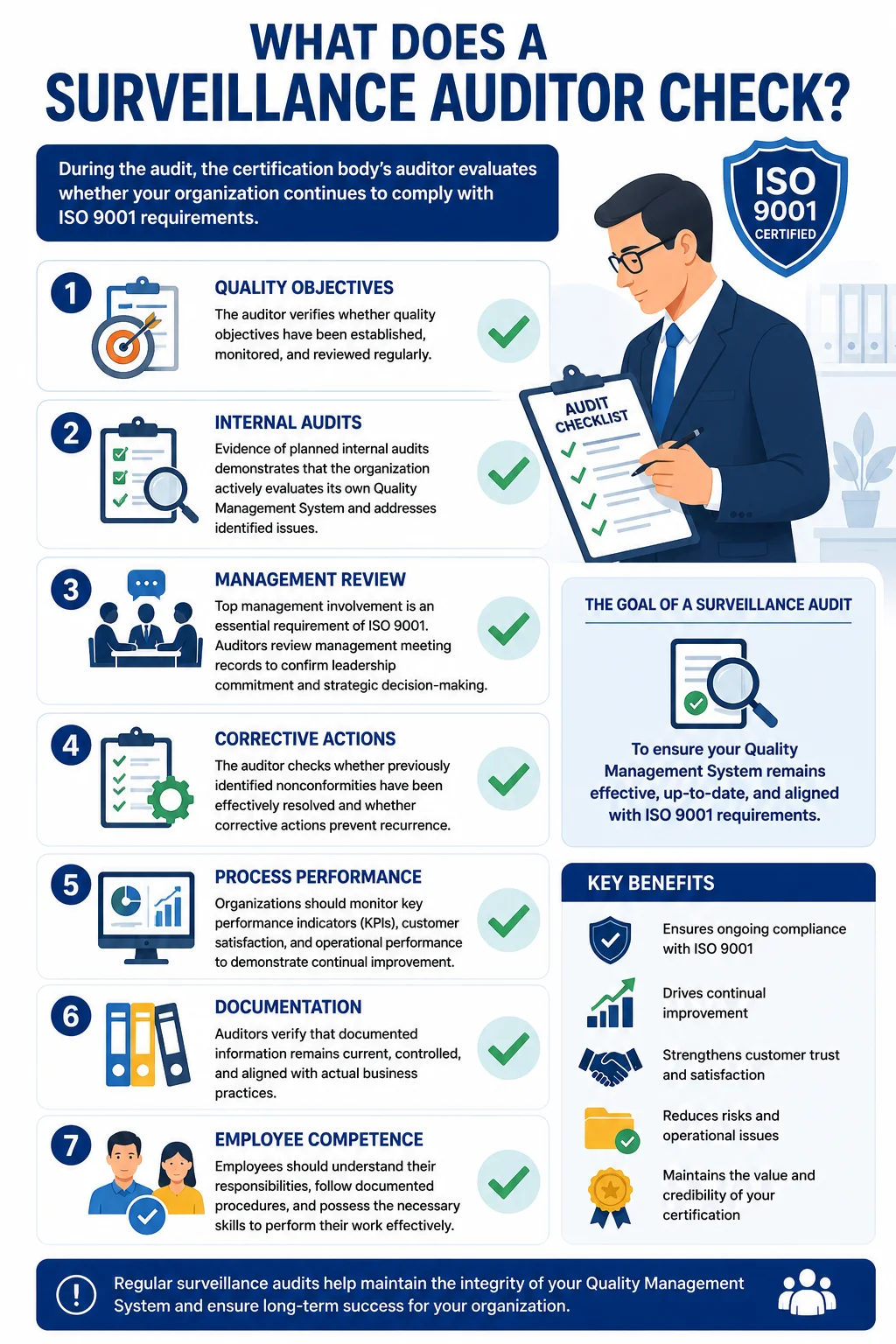
During the audit, the certification body's auditor evaluates whether your organization continues to comply with ISO 9001 requirements. Common areas reviewed include:
Quality Objectives
The auditor verifies whether quality objectives have been established, monitored, and reviewed regularly.
Internal Audits
Evidence of planned internal audits demonstrates that the organization actively evaluates its own Quality Management System and addresses identified issues.
Management Review
Top management involvement is an essential requirement of ISO 9001. Auditors review management meeting records to confirm leadership commitment and strategic decision-making.
Corrective Actions
The auditor checks whether previously identified nonconformities have been effectively resolved and whether corrective actions prevent recurrence.
Process Performance
Organizations should monitor key performance indicators (KPIs), customer satisfaction, and operational performance to demonstrate continual improvement.
Documentation
Auditors verify that documented information remains current, controlled, and aligned with actual business practices.
Employee Competence
Employees should understand their responsibilities, follow documented procedures, and possess the necessary skills to perform their work effectively.
Surveillance Audit vs. Certification Audit
Although both audits evaluate compliance with ISO 9001, they serve different purposes.
| Certification Audit | Surveillance Audit |
|---|---|
| Conducted before certification | Conducted after certification |
| Reviews the complete Quality Management System | Reviews selected processes and ongoing compliance |
| Determines eligibility for certification | Confirms continued certification |
| More comprehensive | Generally shorter and more focused |
How Often Are Surveillance Audits Conducted?
Most accredited certification bodies conduct surveillance audits once every 12 months during the three-year certification cycle.
- Year 1: Initial Certification Audit (Stage 1 and Stage 2)
- Year 2: First Surveillance Audit
- Year 3: Second Surveillance Audit
- End of Year 3: Recertification Audit
This cycle helps ensure that organizations maintain compliance throughout the validity of their certificate.
How to Prepare for an ISO 9001 Surveillance Audit
Organizations can improve audit outcomes by following these best practices:
- Conduct regular internal audits
- Review Quality Objectives and KPIs
- Update documentation when processes change
- Train employees on ISO 9001 requirements
- Address previous audit findings promptly
- Maintain records of corrective actions
- Conduct regular management review meetings
- Monitor customer feedback and complaints
Preparation should be an ongoing activity rather than a last-minute effort before the audit.
Common Nonconformities Found During Surveillance Audits
Organizations may receive nonconformities if auditors identify issues such as:
- Outdated or missing documentation
- Incomplete internal audits
- Ineffective corrective actions
- Lack of employee awareness
- Failure to monitor quality objectives
- Poor record management
- Inadequate management review
Addressing these issues proactively helps maintain certification and supports continual improvement.
Benefits of Successfully Passing a Surveillance Audit
A successful surveillance audit offers several business advantages, including:
- Continued validity of your ISO 9001 certification
- Increased customer confidence
- Improved operational performance
- Stronger regulatory compliance
- Better risk management
- Enhanced business reputation
- Ongoing process improvement
- Greater competitiveness in local and international markets
Why Choose First Cert for ISO 9001 Certification?
Maintaining ISO 9001 certification requires continuous commitment, expert guidance, and a well-managed Quality Management System. First Cert supports organizations throughout the entire certification lifecycle—not only during the initial certification process but also through surveillance audits and recertification.
Our experienced consultants provide comprehensive support, including gap analysis, QMS implementation, documentation development, employee training, internal audits, corrective action planning, and audit preparation. We work closely with organizations of all sizes to ensure they remain compliant with ISO 9001:2015 requirements while improving operational performance.
Whether you're preparing for your first surveillance audit or planning to achieve ISO 9001 certification, we always help simplify the process and ensure a successful outcome.
Conclusion
An ISO 9001 surveillance audit is an essential part of maintaining your certification and demonstrating your organization's ongoing commitment to quality. Rather than viewing surveillance audits as a compliance exercise, organizations should treat them as opportunities to evaluate performance, improve processes, and strengthen customer confidence.
With proper planning, regular internal audits, effective documentation, and continual improvement, surveillance audits become a valuable tool for long-term business success.
To understand the complete ISO 9001 certification process, requirements, costs, and benefits, visit our detailed guide on ISO 9001 Certification: