
ISO 9001 Certification Requirements: A Complete Guide for Businesses
Understanding ISO 9001 Certification Requirements is the first step toward building a strong Quality Management System (QMS) that improves customer satisfaction, operational efficiency, and business performance. ISO 9001 is the world's most recognized Quality Management System standard and can be implemented by organizations of any size or industry. It provides a structured framework for delivering consistent products and services while driving continual improvement.
Whether you're a startup, SME, or multinational enterprise, meeting ISO 9001 certification requirements can enhance customer trust, improve internal processes, and create new business opportunities.
What Are ISO 9001 Certification Requirements?
ISO 9001 certification requirements are the mandatory elements an organization must implement to establish, maintain, and continually improve a Quality Management System (QMS). Certification is achieved after an independent certification body verifies that your management system complies with the requirements of ISO 9001:2015. The standard is based on the principles of customer focus, leadership, process management, risk-based thinking, evidence-based decision-making, and continual improvement.
Key ISO 9001 Certification Requirements
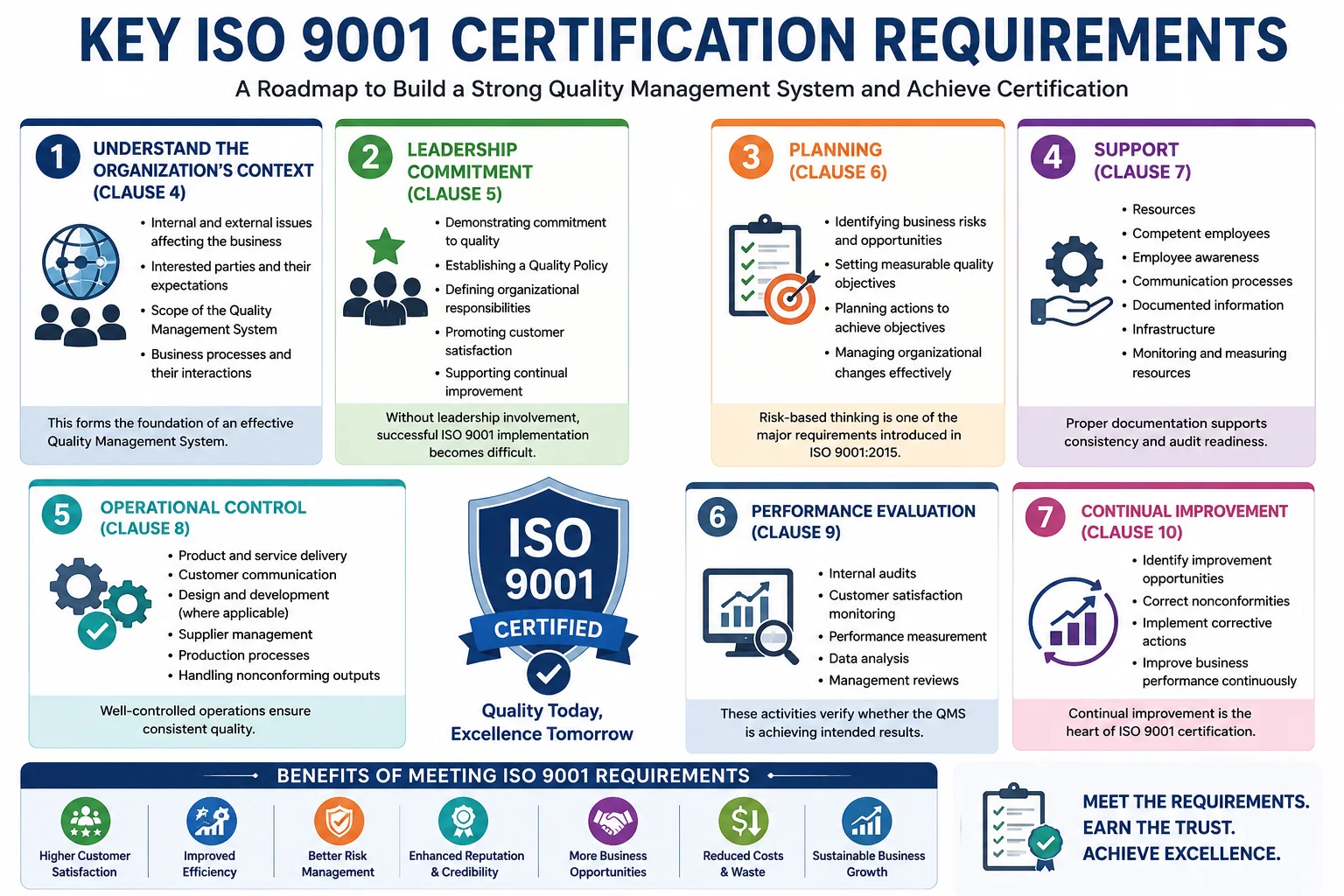
1. Understand the Organization's Context (Clause 4)
Organizations must identify:
- Internal and external issues affecting the business
- Interested parties and their expectations
- Scope of the Quality Management System
- Business processes and their interactions
This forms the foundation of an effective Quality Management System.
2. Leadership Commitment (Clause 5)
Top management plays a critical role by:
- Demonstrating commitment to quality
- Establishing a Quality Policy
- Defining organizational responsibilities
- Promoting customer satisfaction
- Supporting continual improvement
Without leadership involvement, successful ISO 9001 implementation becomes difficult.
3. Planning (Clause 6)
Planning includes:
- Identifying business risks and opportunities
- Setting measurable quality objectives
- Planning actions to achieve objectives
- Managing organizational changes effectively
Risk-based thinking is one of the major requirements introduced in ISO 9001:2015.
4. Support (Clause 7)
Organizations must provide adequate:
- Resources
- Competent employees
- Employee awareness
- Communication processes
- Documented information
- Infrastructure
- Monitoring and measuring resources
Proper documentation supports consistency and audit readiness.
5. Operational Control (Clause 8)
Organizations should establish controls for:
- Product and service delivery
- Customer communication
- Design and development (where applicable)
- Supplier management
- Production processes
- Handling nonconforming outputs
Well-controlled operations ensure consistent quality.
6. Performance Evaluation (Clause 9)
Businesses must evaluate the effectiveness of their Quality Management System through:
- Internal audits
- Customer satisfaction monitoring
- Performance measurement
- Data analysis
- Management reviews
These activities verify whether the QMS is achieving intended results.
7. Continual Improvement (Clause 10)
Organizations are expected to:
- Identify improvement opportunities
- Correct nonconformities
- Implement corrective actions
- Improve business performance continuously
Continual improvement is the heart of ISO 9001 certification.
Essential Documents Required for ISO 9001 Certification
Although ISO 9001 is flexible, organizations generally maintain documents such as:
- Quality Policy
- Quality Objectives
- QMS Scope
- Process Maps
- Risk Assessment Records
- Internal Audit Reports
- Management Review Minutes
- Corrective Action Records
- Employee Competency Records
- Customer Feedback Records
- Supplier Evaluation Records
The exact documentation depends on your organization's size, complexity, and business activities.
ISO 9001 Certification Process
The certification journey typically includes:
- Gap Analysis
- QMS Planning
- Documentation Development
- Process Implementation
- Employee Training
- Internal Audit
- Management Review
- Certification Audit (Stage 1)
- Certification Audit (Stage 2)
- Certificate Issuance
- Annual Surveillance Audits
Benefits of Meeting ISO 9001 Certification Requirements
Organizations implementing ISO 9001 experience numerous advantages, including:
- Improved customer satisfaction
- Better operational efficiency
- Reduced process errors
- Increased employee engagement
- Enhanced brand credibility
- Better risk management
- Improved regulatory compliance
- Increased business opportunities
- Competitive advantage during tenders
- Culture of continual improvement
Common Challenges During ISO 9001 Implementation
Businesses may face challenges such as:
- Lack of management commitment
- Poor documentation practices
- Employee resistance to change
- Limited understanding of ISO requirements
- Inadequate internal audits
Working with experienced ISO consultants helps organizations overcome these challenges efficiently.
Why Choose First Cert for ISO 9001 Certification?
Choosing the right certification partner can make your ISO 9001 certification journey faster, simpler, and more efficient. First Cert offers end-to-end support with experienced ISO consultants, industry-specific expertise, practical documentation assistance, fast certification guidance, and ongoing compliance support to help organizations successfully implement and maintain an effective Quality Management System (QMS).
Whether you are pursuing ISO 9001 certification for the first time or looking to improve your existing management system, First Cert provides tailored solutions that meet your business needs while ensuring compliance with international standards. To learn more about our ISO 9001 services, visit ISO 9001 Certification.
Conclusion
Understanding and implementing ISO 9001 Certification Requirements enables organizations to establish a robust Quality Management System that improves operational performance, customer satisfaction, and long-term business growth. By aligning your processes with internationally recognized quality standards, your business can strengthen its reputation, reduce operational risks, and unlock new market opportunities.
For expert guidance and a smooth certification journey, partner with First Cert, your trusted ISO certification consulting provider committed to helping businesses achieve compliance with confidence.
Frequently Asked Questions (FAQs)
Who can apply for ISO 9001 certification?
Any organization, regardless of size or industry, can implement and obtain ISO 9001 certification.
Is documentation mandatory for ISO 9001?
Yes. Organizations must maintain documented information necessary to support the effective operation of their Quality Management System.
How long does ISO 9001 certification remain valid?
The certificate is generally valid for three years, with annual surveillance audits to verify ongoing compliance.
Can small businesses get ISO 9001 certified?
Absolutely. ISO 9001 is designed to be scalable and can be implemented by startups, SMEs, and large enterprises alike.
Does ISO 9001 improve customer satisfaction?
Yes. The standard focuses on delivering consistent quality, meeting customer requirements, and driving continual improvement, which typically enhances customer satisfaction.