
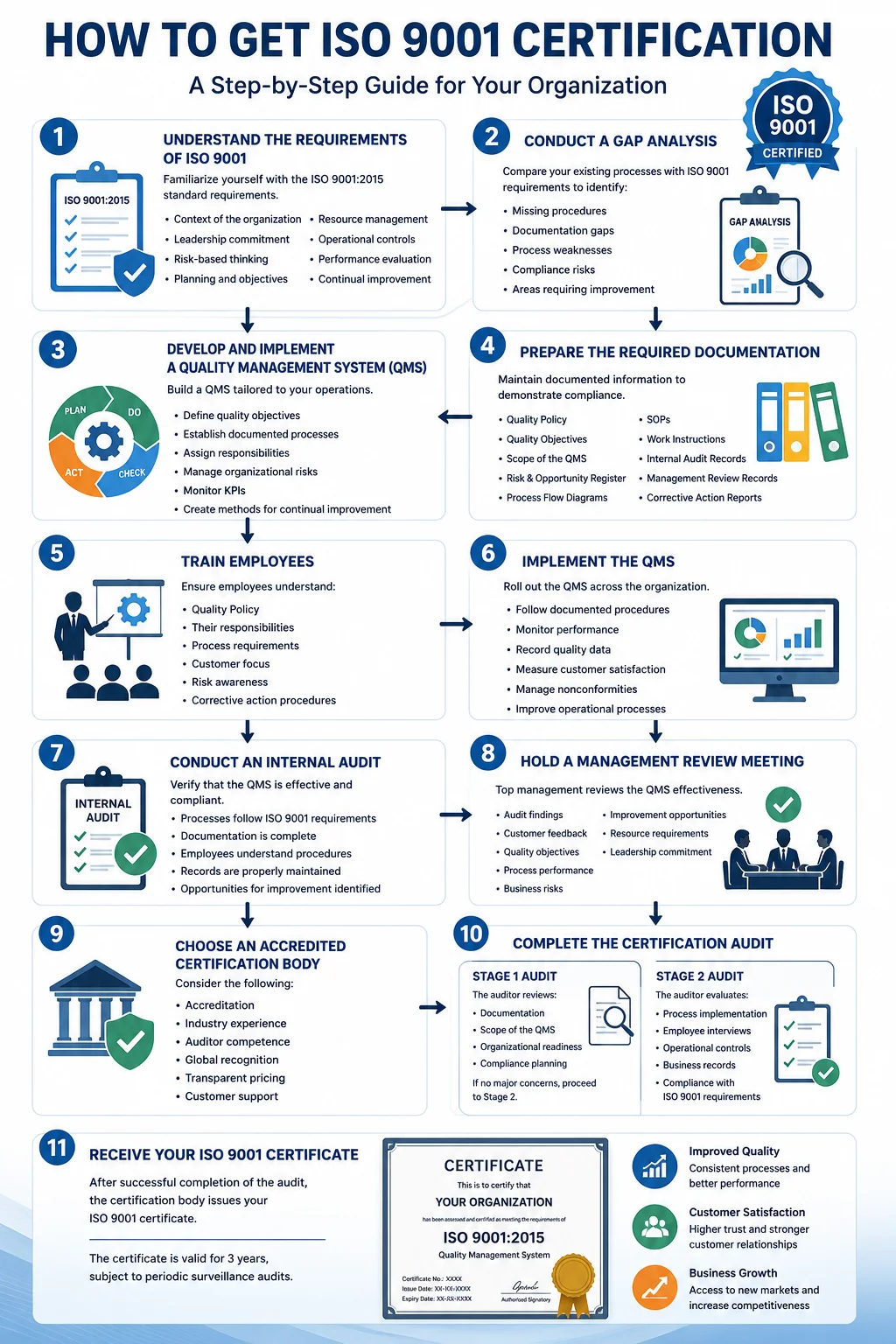
How to Get ISO 9001 Certification: Step-by-Step Process
Organizations across industries are increasingly adopting ISO 9001 certification to demonstrate their commitment to quality, improve operational efficiency, and enhance customer satisfaction. However, many business owners and quality managers ask the same question: How do you get ISO 9001 certification?
The certification process involves more than simply applying for a certificate. It requires implementing an effective Quality Management System (QMS) that complies with the requirements of ISO 9001:2015, followed by an independent audit conducted by an accredited certification body.
This guide explains the complete step-by-step ISO 9001 certification process based on internationally accepted best practices and the ISO 9001 standard.
What Is ISO 9001 Certification?
ISO 9001 is the world's most widely recognized standard for Quality Management Systems (QMS). Published by the International Organization for Standardization (ISO), it provides organizations with a structured framework to consistently deliver products and services that meet customer and regulatory requirements while promoting continual improvement.
Unlike product certification, ISO 9001 certifies an organization's management system rather than individual products or services.
Step 1: Understand the Requirements of ISO 9001
Before beginning implementation, organizations should become familiar with the requirements of the ISO 9001:2015 standard. Key areas include:
- Context of the organization
- Leadership commitment
- Risk-based thinking
- Planning and objectives
- Resource management
- Operational controls
- Performance evaluation
- Continual improvement
Understanding these clauses helps management develop an implementation plan that aligns with business objectives.
Step 2: Conduct a Gap Analysis
A gap analysis compares your existing business processes against the requirements of ISO 9001. This assessment helps identify:
- Missing procedures
- Documentation gaps
- Process weaknesses
- Compliance risks
- Areas requiring improvement
A well-executed gap analysis saves both time and implementation costs by prioritizing necessary improvements before the certification audit.
Step 3: Develop and Implement a Quality Management System (QMS)
Once the gaps have been identified, the organization should develop a Quality Management System tailored to its operations. This includes:
- Defining quality objectives
- Establishing documented processes
- Assigning responsibilities
- Managing organizational risks
- Monitoring key performance indicators (KPIs)
- Creating methods for continual improvement
The QMS should reflect how the organization actually operates rather than being a collection of generic templates.
Step 4: Prepare the Required Documentation
ISO 9001 requires organizations to maintain documented information that demonstrates compliance. Typical documentation includes:
- Quality Policy
- Quality Objectives
- Scope of the QMS
- Risk and Opportunity Register
- Process Flow Diagrams
- Standard Operating Procedures (SOPs)
- Work Instructions
- Internal Audit Records
- Management Review Records
- Corrective Action Reports
Documentation should remain practical, current, and aligned with day-to-day operations.
Step 5: Train Employees
Employee awareness is essential for successful implementation. Training should ensure employees understand:
- The organization's Quality Policy
- Their individual responsibilities
- Process requirements
- Customer focus
- Risk awareness
- Corrective action procedures
When employees understand how their work contributes to quality objectives, organizations typically experience better compliance and stronger operational performance.
Step 6: Implement the QMS
After documentation and training are complete, the Quality Management System should be fully implemented throughout the organization. During this stage, organizations begin:
- Following documented procedures
- Monitoring performance
- Recording quality data
- Measuring customer satisfaction
- Managing nonconformities
- Improving operational processes
Most certification bodies expect the QMS to be operating effectively before the certification audit.
Step 7: Conduct an Internal Audit
Before inviting an external certification body, organizations should perform an internal audit. The purpose is to verify that:
- Processes follow ISO 9001 requirements
- Documentation is complete
- Employees understand procedures
- Records are properly maintained
- Opportunities for improvement are identified
Internal audits help detect issues early, reducing the likelihood of nonconformities during the certification audit.
Step 8: Hold a Management Review Meeting
Top management must review the effectiveness of the Quality Management System. The review typically evaluates:
- Audit findings
- Customer feedback
- Quality objectives
- Process performance
- Business risks
- Improvement opportunities
- Resource requirements
Management involvement demonstrates leadership commitment, which is a core requirement of ISO 9001.
Step 9: Choose an Accredited Certification Body
Selecting the right certification body is an important decision. Consider the following:
- Accreditation by an internationally recognized accreditation body
- Industry experience
- Auditor competence
- Global recognition
- Transparent pricing
- Customer support
Accreditation ensures the issued certificate is widely accepted by customers, regulators, and international markets.
Step 10: Complete the Certification Audit
The certification audit usually consists of two stages.
Stage 1 Audit
The auditor reviews:
- Documentation
- Scope of the Quality Management System
- Organizational readiness
- Compliance planning
If no major concerns are identified, the organization proceeds to Stage 2.
Stage 2 Audit
The auditor evaluates:
- Process implementation
- Employee interviews
- Operational controls
- Business records
- Compliance with ISO 9001 requirements
If the organization successfully meets the requirements, the certification body recommends certification.
Step 11: Receive Your ISO 9001 Certificate
Once the audit is successfully completed, the certification body issues the ISO 9001 certificate. The certificate is generally valid for three years, subject to periodic surveillance audits that verify the ongoing effectiveness of the Quality Management System.
Maintain and Continually Improve Your QMS
Achieving certification is not the end of the journey. Organizations should continually:
- Monitor performance
- Review customer feedback
- Conduct internal audits
- Address nonconformities
- Improve business processes
- Update documentation when needed
Continual improvement is one of the fundamental principles of ISO 9001 and helps organizations sustain long-term success.
Common Mistakes to Avoid
Organizations often encounter delays because they:
- Copy generic documentation without adapting it
- Ignore employee training
- Skip internal audits
- Fail to involve top management
- Treat certification as a one-time activity rather than an ongoing management system
Avoiding these common mistakes improves the likelihood of a successful certification audit.
Achieve ISO 9001 Certification with First Cert
Successfully achieving ISO 9001 certification requires careful planning, the right documentation, effective implementation, and continuous improvement. While the process may seem complex, having an experienced certification partner can make the journey significantly smoother and more efficient.
At First Cert, we provide comprehensive, end-to-end ISO 9001 consulting services to help organizations achieve certification with confidence. Our experienced consultants work closely with your team throughout every stage of the certification process—from conducting an initial gap analysis and developing a compliant Quality Management System (QMS) to preparing documentation, training employees, conducting internal audits, and coordinating with accredited certification bodies.
We understand that every organization has unique objectives and operational requirements. That's why our approach is tailored to your business, ensuring your Quality Management System not only meets ISO 9001:2015 requirements but also supports long-term operational excellence and continual improvement.
Whether you're a startup, a small or medium-sized enterprise (SME), or a large multinational organization, First Cert is committed to making your certification journey straightforward, efficient, and cost-effective.
Ready to Get ISO 9001 Certified?
Let First Cert be your trusted certification partner. Our experts will guide you through every step—from planning and implementation to the successful completion of your certification audit—so you can focus on growing your business while we help you achieve compliance.
Conclusion
Obtaining ISO 9001 certification is a structured process that requires planning, implementation, employee involvement, internal audits, and independent certification. While the process requires commitment, the long-term benefits—including improved quality, stronger customer confidence, increased operational efficiency, and greater business opportunities—make it a valuable investment for organizations of all sizes.
By following these step-by-step best practices and working with experienced professionals, organizations can achieve ISO 9001 certification efficiently while building a culture of continual improvement and sustainable business growth.